

Has Anyone Attached A Deep Sea Camera To A Sperm Whale?
| Anglerfish Temporal range: | |
|---|---|
 | |
| Humpback anglerfish, Melanocetus johnsonii | |
Scientific nomenclature  | |
| Kingdom: | Animalia |
| Phylum: | Chordata |
| Course: | Actinopterygii |
| Clade: | Percomorpha |
| Gild: | Lophiiformes Garman, 1899 |
| Blazon species | |
| Lophius piscatorius Linnaeus, 1758 | |

(A) Centrophryne spinulosa, 136 mm SL
(B) Cryptopsaras couesii, 34.5 mm SL
(C) Himantolophus appelii, 124 mm SL
(D) Diceratias trilobus, 86 mm SL
(East) Bufoceratias wedli, 96 mm SL
(F) Bufoceratias shaoi, 101 mm SL
(Chiliad) Melanocetus eustalus, 93 mm SL
(H) Lasiognathus amphirhamphus, 157 mm SL
(I) Thaumatichthys binghami, 83 mm SL
(J) Chaenophryne quasiramifera, 157 mm SL.
The anglerfish are fish of the teleost social club Lophiiformes ().[1] They are bony fish named for their feature mode of predation, in which a modified luminescent fin ray (the esca or illicium) acts as a lure for other fish. The luminescence comes from symbiotic bacteria, which are thought to exist caused from seawater,[2] [iii] that dwell in and around the sea.
Some anglerfish are notable for extreme sexual dimorphism and sexual symbiosis of the small male person with the much larger female, seen in the suborder Ceratiidae, the deep sea anglerfish. In these species, males may be several orders of magnitude smaller than females.[four]
Anglerfish occur worldwide. Some are pelagic (habitation abroad from the sea floor), while others are benthic (habitation close to the sea flooring). Some live in the deep sea (such as the Ceratiidae), while others on the continental shelf, such every bit the frogfishes and the Lophiidae (monkfish or goosefish). Pelagic forms are virtually often laterally compressed, whereas the benthic forms are oft extremely dorsoventrally compressed (depressed), often with large up-pointing mouths.[ citation needed ]
Evolution [edit]
A mitochondrial genome phylogenetic study suggested the anglerfishes diversified in a brusk period of the early on to mid-Cretaceous, between 130 and 100 1000000 years agone.[5]
Classification [edit]
FishBase,[1] Nelson,[6] and Pietsch[seven] list xviii families, but ITIS[eight] lists only 16. The following taxa take been bundled to evidence their evolutionary relationships.[4]
- Suborder Lophoiodei
- Lophiidae (goosefishes or monkfishes)
- Suborder Antennarioidei
- Antennariidae (frogfishes)
- Tetrabrachiidae (four-armed frogfishes)[nine]
- Brachionichthyidae (handfishes)
- Lophichthyidae (Boschma's frogfish)[9]
- Suborder Chaunacoidei
- Chaunacidae (sea toads)
- Suborder Ogcocephaloidei
- Ogcocephalidae (batfishes)
- Suborder Ceratioidei
- Centrophrynidae (prickly seadevils)
- Ceratiidae (warty seadevils)
- Himantolophidae (footballfishes)
- Diceratiidae (doublespine seadevils)
- Melanocetidae (blackness seadevils)
- Thaumatichthyidae (wolf-trap seadevils)
- Oneirodidae (dreamers)
- Caulophrynidae (fanfin seadevils)
- Neoceratiidae (needlebeard seadevil)
- Gigantactinidae (whipnose seadevils)
- Linophrynidae (leftvent seadevils)

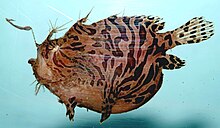
Striped anglerfish (Antennarius striatus)
Beefcake [edit]
All anglerfish are carnivorous and are thus adapted for the capture of prey. Ranging in color from dark grayness to dark dark-brown, abyssal species have big heads that conduct enormous, crescent-shaped mouths full of long, fang-similar teeth angled inward for efficient prey grabbing. Their length can vary from 2–xviii cm (i–7 in), with a few types getting as large every bit 100 cm (39 in),[x] just this variation is largely due to sexual dimorphism, with females being much larger than males.[11] Frogfish and other shallow-h2o anglerfish species are ambush predators, and often announced camouflaged as rocks, sponges or seaweed. [12]
Most adult female ceratioid anglerfish have a luminescent organ called the esca at the tip of a modified dorsal ray (the illicium or fishing rod; derived from Latin ēsca, "bait"). The organ has been hypothesized to serve the obvious purpose of luring casualty in dark, deep-sea environments, merely also serves to phone call males' attending to the females to facilitate mating.
The source of luminescence is symbiotic bacteria that dwell in and around the esca, enclosed in a cup-shaped reflector containing crystals, probably consisting of guanine. Only a handful of luminescent symbiont species can associate with deep-sea anglerfishes.[3] In some species, the leaner recruited to the esca are incapable of luminescence independent of the anglerfish, suggesting they have developed a symbiotic relationship and the bacteria are unable to synthesize all of the chemicals necessary for brilliance on their own. They depend on the fish to make upward the difference. Electron microscopy of these bacteria in some species reveals they are Gram-negative rods that lack capsules, spores, or flagella. They have double-layered cell walls and mesosomes. A pore connects the esca with the seawater, which enables the removal of dead bacteria and cellular waste material, and allows the pH and tonicity of the culture medium to remain abiding. This, as well as the constant temperature of the bathypelagic zone inhabited by these fish, is crucial for the long-term viability of bacterial cultures.[13] [xiv]
The low-cal gland is ever open to the exterior, so it is possible that the fish acquires the bacteria from the seawater. However, it appears that each species uses its ain particular species of leaner, and these leaner have never been found in seawater. Haygood (1993) theorized that esca discharge bacteria during spawning and the bacteria are thereby transferred to the eggs.[14]
Some evidence shows that some anglerfish caused their bioluminescent symbionts from the local surroundings. Genetic materials of the symbiont bacteria is found near the anglerfish, indicating that the anglerfish and their associated bacteria are most probable not evolved together and the bacteria take hard journeys to enter the host.[three] In a study on Ceratioid anglerfish in the Gulf of Mexico, researchers noticed that the confirmed host-associated bioluminescent microbes are not present in the larval specimens and throughout host development. The Ceratioids likely acquired their bioluminescent symbionts from the seawater.[2] Photobacterium phosphoreum and members from kishitanii clade constitute the major or sole bioluminescent symbiont of several families of abyssal luminous fishes.[fifteen]
It is known that genetic makeup of the symbiont leaner has undergone changes since they became associated with their host.[three] Compared to their free-living relatives, deep-body of water anglerfish symbiont genomes are reduced in size past 50%. Reductions in amino acrid synthesis pathways and abilities to apply diverse sugars are found. All the same, genes involved in chemotaxis and motility that are thought to be useful but outside the host are retained in the genome. Symbiont genome contains very high numbers of pseudogenes and bear witness massive expansions of transposable elements. The procedure of genome reduction is however ongoing in these symbionts lineages, and the gene loss may lead to host dependence.[16]
In most species, a wide mouth extends all around the inductive circumference of the head, and bands of inwardly inclined teeth line both jaws. The teeth tin be depressed so as to offering no impediment to an object gliding towards the breadbasket, but forestall its escape from the oral cavity.[17] The anglerfish is able to distend both its jaw and its breadbasket, since its bones are thin and flexible, to enormous size, allowing it to swallow casualty upward to twice every bit large as its entire body.[18]
Behavior [edit]
Swimming and energy conservation [edit]
In 2005, well-nigh Monterey, California, at i,474 metres depth, an ROV filmed a female ceratioid anglerfish of the genus Oneirodes for 24 minutes. When approached, the fish retreated rapidly, just in 74% of the video footage, it drifted passively, oriented at any angle. When advancing, information technology swam intermittently at a speed of 0.24 body lengths per 2nd, chirapsia its pectoral fins in-stage. The lethargic beliefs of this ambush predator is suited to the energy-poor environs of the deep sea.[xix]
Another in situ observation of three different whipnose anglerfish showed unusual inverted swimming-behavior. Fish were observed floating inverted completely motionless with the illicium hanging down stiffly in a slight arch in front end of the fish. The illicium was hanging over modest visible burrows. Information technology was suggested this is an effort to entice prey and an instance of depression-energy opportunistic foraging and predation. When the ROV approached the fish, they exhibited burst pond, yet inverted.[20]
The jaw and stomach of the anglerfish can extend to let it to swallow prey up to twice its size. Because of the express corporeality of food bachelor in the anglerfish's environment, this adaptation allows the anglerfish to store food when in that location is an abundance.[21]
Predation [edit]
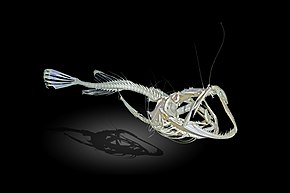
Skeleton of the angler fish Lophius piscatorius: The kickoff spine of the dorsal fin of the anglerfish acts as a line-fishing rod with a lure.
The proper noun "anglerfish" derives from the species' characteristic method of predation. Anglerfish typically take at least one long filament sprouting from the middle of their heads, termed the illicium. The illicium is the detached and modified first three spines of the inductive dorsal fin. In virtually anglerfish species, the longest filament is the first. This first spine protrudes in a higher place the fish's eyes and terminates in an irregular growth of flesh (the esca), and can move in all directions. Anglerfish tin jerk the esca to make information technology resemble a prey animal, which lures the anglerfish'south prey shut enough for the anglerfish to devour them whole.[22] Some abyssal anglerfish of the bathypelagic zone likewise emit light from their esca to attract prey.[23]
Because anglerfish are opportunistic foragers, they show a range of preferred casualty with fish at the extremes of the size spectrum, whilst showing increased selectivity for sure prey. One study examining the stomach contents of threadfin anglerfish off the Pacific declension of Fundamental America establish these fish primarily ate two categories of benthic prey: crustaceans and teleost fish. The most frequent prey were pandalid shrimp. 52% of the stomachs examined were empty, supporting the observations that anglerfish are low free energy consumers.[24]
Reproduction [edit]


Some anglerfish, like those of the Ceratiidae, or bounding main devils employ an unusual mating method.[25] Because individuals are locally rare, encounters are also very rare. Therefore, finding a mate is problematic. When scientists get-go started capturing ceratioid anglerfish, they noticed that all of the specimens were female person. These individuals were a few centimetres in size and almost all of them had what appeared to exist parasites attached to them. Information technology turned out that these "parasites" were highly reduced male ceratioids. This indicates some taxa of anglerfish utilize a polyandrous mating system. In some species of anglerfish, fusion betwixt male and female when reproducing is possible due to the lack of immune system keys that let antibodies to mature and create receptors for T-cells.
Certain ceratioids rely on parabiotic reproduction. Complimentary-living males and unparasitized females in these species never accept fully developed gonads. Thus, males never mature without attaching to a female, and die if they cannot find one.[4] At birth, male ceratioids are already equipped with extremely well-developed olfactory organs[26] that detect scents in the h2o. Males of some species also develop big, highly specialized eyes that may aid in identifying mates in night environments. The male ceratioids are significantly smaller than a female anglerfish, and may have trouble finding food in the deep body of water. Furthermore, growth of the comestible canals of some males becomes stunted, preventing them from feeding. Some taxa accept jaws that are never suitable or effective for prey capture.[26] These features mean the male must apace discover a female anglerfish to prevent death. The sensitive olfactory organs help the male person to detect the pheromones that signal the proximity of a female anglerfish.
The methods anglerfish use to locate mates vary. Some species accept minute optics that are unfit for identifying females, while others have underdeveloped nostrils, making them unlikely to finer find females by scent.[four] When a male finds a female person, he bites into her peel, and releases an enzyme that digests the skin of his mouth and her body, fusing the pair down to the blood-vessel level.[26] The male becomes dependent on the female person host for survival by receiving nutrients via their shared circulatory system, and provides sperm to the female in return. After fusing, males increment in volume and become much larger relative to free-living males of the species. They alive and remain reproductively functional as long every bit the female person lives, and can accept part in multiple spawnings.[4] This extreme sexual dimorphism ensures that when the female is ready to spawn, she has a mate immediately bachelor.[27] Multiple males can be incorporated into a single private female with up to eight males in some species, though some taxa appear to have a "i male per female" rule.[4]
Symbiosis is not the only method of reproduction in anglerfish. In fact, many families, including the Melanocetidae, Himantolophidae, Diceratiidae, and Gigantactinidae, show no evidence of male person symbiosis.[28] Females in some of these species contain large, developed ovaries and free-living males have large testes, suggesting these sexually mature individuals may spawn during a temporary sexual attachment that does non involve fusion of tissue. Males in these species also have well-toothed jaws that are far more effective in hunting than those seen in symbiotic species.[28]
Sexual symbiosis may be an optional strategy in some species of anglerfishes.[four] In the Oneirodidae, females conveying symbiotic males have been reported in Leptacanthichthys and Bertella—and others that were non still developed fully functional gonads.[4] One theory suggests the males attach to females regardless of their own reproductive development if the female is not sexually mature, just when both male and female person are mature, they spawn and so split up.[iv]
| External video | |
|---|---|
 Weird Killer of the Deep – YouTube Weird Killer of the Deep – YouTube | |
| The anglerfish: The original approach to deep-body of water fishing – YouTube | |
| 3D scans reveal deep-sea anglerfish's huge last meal – YouTube |
Ane explanation for the evolution of sexual symbiosis is that the relatively depression density of females in deep-sea environments leaves petty opportunity for mate choice among anglerfish. Females remain large to adjust fecundity, as is evidenced by their large ovaries and eggs. Males would be expected to shrink to reduce metabolic costs in resources-poor environments and would develop highly specialized female-finding abilities. If a male person manages to discover a female, then symbiotic attachment is ultimately more than probable to amend lifetime fitness relative to complimentary living, peculiarly when the prospect of finding future mates is poor. An additional advantage to symbiosis is that the male'due south sperm can be used in multiple fertilizations, equally he e'er remains available to the female for mating. Higher densities of male-female encounters might correlate with species that demonstrate facultative symbiosis or simply utilise a more traditional temporary contact mating.[29]
The spawn of the anglerfish of the genus Lophius consists of a sparse sail of transparent gelatinous material 25 cm (x in) wide and greater than 10 yard (33 ft) long.[30] Such an egg sheet is rare amid fish. The eggs in this sheet are in a single layer, each in its ain cavity. The spawn is free in the ocean. The larvae are costless-swimming and take the pelvic fins elongated into filaments.[17]
Threats [edit]
Northwest European Lophius species are listed by the ICES equally "exterior safe biological limits".[31] Additionally, anglerfish are known to occasionally rise to the surface during El Niño, leaving large groups of expressionless anglerfish floating on the surface.[31]
In 2010, Greenpeace International added the American angler (Lophius americanus), the angler (Lophius piscatorius), and the black-bellied angler (Lophius budegassa) to its seafood red listing—a list of fish commonly sold worldwide with a high likelihood of being sourced from unsustainable fisheries.[32]
Human consumption [edit]
One family, the Lophiidae, is of commercial interest with fisheries found in western Europe, eastern North America, Africa, and Eastward Asia. In Europe and Due north America, the tail meat of fish of the genus Lophius, known as monkfish or goosefish (North America), is widely used in cooking, and is often compared to lobster tail in gustatory modality and texture.
In Asia, especially Korea and Japan, monkfish liver, known as ankimo, is considered a delicacy.[33] Anglerfish is especially heavily consumed in South korea, where information technology is featured as the main ingredient in dishes such as Agujjim.
Timeline of genera [edit]
Anglerfish appear in the fossil tape as follows:[34]

References [edit]
- ^ a b Froese, Rainer, and Daniel Pauly, eds. (2006). "Lophiiformes" in FishBase. February 2006 version.
- ^ a b Freed, Lindsay L; Easson, Cole; Bakery, Lydia J; Fenolio, Danté; Sutton, Tracey T; Khan, Yasmin; Blackwelder, Patricia; Hendry, Tory A; Lopez, Jose V (ane October 2019). "Characterization of the microbiome and bioluminescent symbionts across life stages of Ceratioid Anglerfishes of the Gulf of Mexico". FEMS Microbiology Environmental. 95 (x): fiz146. doi:x.1093/femsec/fiz146. ISSN 0168-6496. PMC6778416. PMID 31504465.
- ^ a b c d Baker, Lydia J; Freed, Lindsay Fifty; Easson, Cole Thousand; Lopez, Jose V; Fenolio, Danté; Sutton, Tracey T; Nyholm, Spencer V; Hendry, Tory A (1 Oct 2019). "Diverse deep-sea anglerfishes share a genetically reduced luminous symbiont that is caused from the surroundings". eLife. 8: e47606. doi:10.7554/eLife.47606. ISSN 2050-084X. PMC6773444. PMID 31571583.
- ^ a b c d e f g h i Pietsch, Theodore W. (25 August 2005). "Dimorphism, parasitism, and sex revisited: modes of reproduction among abyssal ceratioid anglerfishes (Teleostei: Lophiiformes)". Ichthyological Research. 52 (three): 207–236. doi:ten.1007/s10228-005-0286-2. S2CID 24768783.
- ^ Miya, M.; T. Pietsch; J. Orr; R. Arnold; T. Satoh; A. Shedlock; H. Ho; K. Shimazaki; M. Yabe (2010). "Evolutionary history of anglerfishes (Teleostei: Lophiiformes): a mitogenomic perspective". BMC Evolutionary Biological science. 10: 58. doi:ten.1186/1471-2148-x-58. PMC2836326. PMID 20178642.
- ^ Joseph South. Nelson (29 April 1994). Fishes of the World. John Wiley & Sons. ISBN978-0-471-54713-half-dozen.
- ^ Theodore Westward. Pietsch (2009) (2009). Oceanic Anglerfishes: Extraordinary Diversity in the Deep Sea. University of California Printing. ISBN978-0-520-25542-v.
- ^ "Lophiiformes". Integrated Taxonomic Data System. Retrieved three April 2006.
- ^ a b Boschma's frogfish and the four-armed frogfish are included in the Antennariidae in ITIS.
- ^ "Anglerfish". National Geographic. 10 September 2010. Retrieved 28 Feb 2019.
- ^ "Fish Identification". fishbase.org . Retrieved 28 January 2019.
- ^ "Camouflage". Retrieved 22 Jan 2018.
- ^ O'Day, William T. (1974). Bacterial Luminescence in the Deep-Sea Anglerfish (PDF). LA: Natural History Museum of Los Angeles County.
- ^ a b Munk, Ole; Hansen, Kjeld; Herring, Peter J. (2009). "On the Development and Structure of the Escal Calorie-free Organ of Some Melanocetid Deep Ocean Anglerfishes (Pisces: Ceratioidei)". Journal of the Marine Biological Clan of the U.k.. 78 (4): 1321. doi:10.1017/S0025315400044520. ISSN 0025-3154.
- ^ Haygood, Margo Grand.; Distel, Daniel L. (May 1993). "Bioluminescent symbionts of flashlight fishes and deep-body of water anglerfishes form unique lineages related to the genus Vibrio". Nature. 363 (6425): 154–156. Bibcode:1993Natur.363..154H. doi:10.1038/363154a0. ISSN 0028-0836. PMID 7683390. S2CID 4346611.
- ^ Hendry, Tory A.; Freed, Lindsay L.; Fader, Dana; Fenolio, Danté; Sutton, Tracey T.; Lopez, Jose 5. (26 June 2018). Moran, Nancy A. (ed.). "Ongoing Transposon-Mediated Genome Reduction in the Luminous Bacterial Symbionts of Deep-sea Ceratioid Anglerfishes". mBio. 9 (iii): e01033–xviii, /mbio/9/3/mBio.01033–18.cantlet. doi:10.1128/mBio.01033-18. ISSN 2150-7511. PMC6020299. PMID 29946051.
- ^ a b One or more of the preceding sentences incorporates text from a publication now in the public domain:Chisholm, Hugh, ed. (1911). "Angler". Encyclopædia Britannica. Vol. two (11th ed.). Cambridge University Press. p. 15.
- ^ "Anglerfish". National Geographic. 10 September 2010. Retrieved eighteen April 2018.
- ^ Luck, Daniel Garcia; Pietsch, Theodore West. (4 June 2008). "Observations of a Abyssal Ceratioid Anglerfish of the Genus Oneirodes (Lophiiformes: Oneirodidae)". Copeia. 2008 (ii): 446–451. doi:10.1643/CE-07-075. S2CID 55297852.
- ^ Moore, Jon A. (31 Dec 2001). "Upside-Downward Swimming Behavior in a Whipnose Anglerfish (Teleostei: Ceratioidei: Gigantactinidae)". Copeia. 4. 2002 (four): 1144–1146. doi:ten.1643/0045-8511(2002)002[1144:udsbia]2.0.co;ii. JSTOR 1448539.
- ^ "Deep Sea Anglerfish - Deep Body of water Creatures on Sea and Sky".
- ^ Smith, William John (2009). The Behavior of Communicating: an ethological approach. Harvard Academy Printing. p. 381. ISBN978-0-674-04379-4.
Others rely on the technique adopted by a wolf in sheep's habiliment—they mimic a harmless species. ... Other predators fifty-fifty mimic their prey's prey: angler fish (Lophiiformes) and alligator snapping turtles Macroclemys temmincki can wriggle fleshy outgrowths of their fins or tongues and attract small-scale predatory fish close to their mouths.
- ^ Piper, Ross (2007), Extraordinary Animals: An Encyclopedia of Curious and Unusual Animals, Greenwood Press.
- ^ Espinoza, Mario; Ingo Wehrtmann (2008). "Tummy content analyses of the threadfin anglerfish Lophiodes spilurus (Lophiiformes: Lophiidae) associated with deepwater shrimp fisheries from the fundamental Pacific of Costa Rica". Revista de Biología Tropical. iv. 56 (4): 1959–lxx. doi:10.15517/rbt.v56i4.5772. PMID 19419094. Retrieved 4 October 2013.
- ^ Gorey, Colm (23 March 2018). "Scientists stunned to capture start mating footage of baroque anglerfish". SiliconRepublic.com . Retrieved 23 March 2018.
- ^ a b c Gould, Stephen Jay (1983). Hen's Teeth and Horse'southward Toes . New York: Westward. West. Norton & Company. p. 30. ISBN978-0-393-01716-8.
ceratioid males develop gigantic nostrils...relative to trunk size, some ceratioids accept larger nasal organs than whatsoever other vertebrate
- ^ Theodore Due west. Pietsch (1975). "Precocious sexual parasitism in the deep sea ceratioid anglerfish, Cryptopsaras couesi Gill". Nature. 256 (5512): 38–40. Bibcode:1975Natur.256...38P. doi:x.1038/256038a0. S2CID 4226567.
- ^ a b Pietsch, Theodore West. (viii March 1972). "A Review of the Monotypic Deep-Sea Anglerfish Family Centrophrynidae: Taxonomy, Distribution and Osteology". Copeia. 1972 (i): 17–47. doi:10.2307/1442779. JSTOR 1442779.
- ^ Miya, Masaki; Pietsch, Theodore West; Orr, James W; Arnold, Rachel J; Satoh, Takashi P; Shedlock, Andrew M; Ho, Hsuan-Ching; Shimazaki, Mitsuomi; Yabe, Mamoru; Nishida, Mutsumi (one January 2010). "Evolutionary history of anglerfishes (Teleostei: Lophiiformes): a mitogenomic perspective". BMC Evolutionary Biological science. 10 (1): 58. doi:x.1186/1471-2148-10-58. PMC2836326. PMID 20178642.
- ^ Prince, Eastward. E. 1891. Notes on the development of the angler-fish (Lophius piscatorius). Ninth Annual Report of the Fishery Lath for Scotland (1890), Part III: 343–348.
- ^ a b Clover, Charles (2004). The End of the Line: How overfishing is changing the world and what we swallow. London: Ebury Press. ISBN978-0-09-189780-ii.
- ^ Greenpeace International Seafood Cherry list Archived twenty August 2010 at the Wayback Machine
- ^ "Goosefish". All the Sea. Retrieved xx April 2012.
- ^ Sepkoski, Jack (2002). "A compendium of fossil marine animal genera". Bulletins of American Paleontology. 364: 560. Archived from the original on 23 July 2011. Retrieved 17 May 2011.

Further reading [edit]
- Anderson, Yard. Eric, and Leslie, Robin West. 2001. Review of the abyssal anglerfishes (Lophiiformes: Ceratioidei) of southern Africa. Ichthyological Bulletin of the J.L.B. Smith Constitute of Ichthyology; No. 70. J.Fifty.B. Smith Institute of Ichthyology, Rhodes University
External links [edit]
- Tree of Life spider web project: Lophiiformes
- Video (02:37) – Anglerfish mating on YouTube
- Lu, D. Anglerfish immune system lets them fuse with their mate. New Scientist 247, 19 (2020).
Source: https://en.wikipedia.org/wiki/Anglerfish
Posted by: mooreoffing.blogspot.com
0 Response to "Has Anyone Attached A Deep Sea Camera To A Sperm Whale?"
Post a Comment