

3.10 Quiz Food And Nutrition
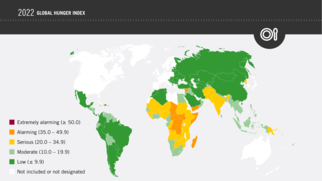
2022 Global Hunger Index past Severity
The Global Hunger Index (GHI) is a tool that attempts to measure and track hunger globally as well as past region and by country, prepared by European NGOs of Concern Worldwide and Welthungerhilfe.[1] The GHI is calculated annually, and its results appear in a report issued in October each yr.[two] [3]
The 2022 Global Hunger Index shows a dramatic hunger situation worldwide. Global progress in catastrophe Hunger is at a near standstill. The main drivers of hunger are conflicts, the climate crisis, and the economic consequences of the COVID-nineteen pandemic. These drivers come on tiptop of underlying factors such as poverty, inequality, inadequate governance. The situation is expected to continue to worsen in the face of overlapping global crises. Without fundamental changes, the goal of Zilch Hunger by 2030 will not be achieved.
Global Hunger Index Written report [edit]
Created in 2006, the GHI was initially published by the Us-based International Food Policy Research Institute (IFPRI) and Germany-based Welthungerhilfe. In 2007, the Irish gaelic NGO Concern Worldwide also became a co-publisher.[4] [5] [six] [7] [8] [9] [10] [11] [12] [13] [14] [15] [16] [17] In 2018, IFPRI withdrew from the project and the GHI became a articulation project of Welthungerhilfe and Concern Worldwide.[18]
The Global Hunger Index report presents a multidimensional mensurate of national, regional, and global hunger by assigning a numerical score based on several aspects of hunger. Countries are then ranked by GHI score and compared to previous scores from iii reference years (e.g., the 2022 GHI scores can be directly compared to 2000, 2007 and 2014 GHI scores) to provide an cess of progress over fourth dimension. In improver to presenting GHI scores, the GHI study includes an essay that covers an annually changing focus topic related to hunger. The 2022 report focuses on community action that engages local leaders and citizens in improving food systems governance and accountability and provides policy recommendations on how to answer to current emergencies while also transforming food systems, so they are more equitable, inclusive, sustainable, and resilient.
Calculation of GHI scores [edit]
Based on the values of the four indicators, a GHI score is calculated on a 100-bespeak scale reflecting the severity of hunger, where 0 is the best possible score (no hunger) and 100 is the worst. Each country'southward GHI score is classified by severity, from low to extremely alarming.[19]
| Level | Value |
|---|---|
| Low | 9.9 |
| Moderate | 10.0-19.9 |
| Serious | 20.0-34.9 |
| Alarming | 35.0-49.9 |
| Extremely alarming | ≥ 50.0 |
The GHI combines 4 component indicators:[GHI2016 1]
- Undernourishment: the share of the population with bereft caloric intake.
- Child stunting: the share of children under historic period five who accept low height for their historic period, reflecting chronic undernutrition.
- Child wasting: the share of children under age v who have low weight for their meridian, reflecting acute undernutrition.
- Child bloodshed: the share of children who die before their fifth birthday, reflecting in part the fatal mix of inadequate diet and unhealthy environments.
In 2022, data were assessed for the 136 countries that met the criteria for inclusion in the GHI, and GHI scores were calculated for 121 of those countries based on data from 2017 to 2021. The data used to calculate GHI scores come from published United Nations sources (Food and Agriculture Organization of the United nations,[20] World Wellness Arrangement, UNICEF, and Inter-agency Group for Child Mortality Estimation[21]), the Globe Bank, and Demographic and Health Surveys.
For 15 countries, individual scores could not exist calculated, and ranks could not exist determined attributable to lack of data. 8 countries were provisionally designated past severity based on other published data. For the remaining 7 countries, data were insufficient to allow for either calculating GHI scores or assigning conditional categories.
In previous years, topics included:
- 2010: Early on babyhood undernutrition amidst children younger than the age of two.[22]
- 2011: Ascent and more volatile nutrient prices of the recent years and the effects these changes accept on hunger and malnutrition.[23]
- 2012: Achieving nutrient security and sustainable use of natural resources, when the natural sources of food become increasingly scarce.[24]
- 2013: Strengthening community resilience against undernutrition and malnutrition.[25]
- 2014: Hidden hunger, a form of undernutrition characterized by micronutrient deficiencies.[26]
- 2015: Armed disharmonize and its relation to hunger.[27]
- 2016: Reaching the UN Sustainable Evolution Goal of zero hunger past 2030.[28]
- 2017: The challenges of inequality and hunger.[29]
- 2018: Forced migration and hunger.[xxx]
- 2019: Climate change and hunger.[31]
- 2020: "I decade to Nix Hunger: Linking wellness and sustainable food systems".
- 2021:Hunger and Food Systems in Conflict Settings.
- 2022:Food Systems Transformation and Local Governance.[32]
In add-on to the yearly GHI, the Hunger Alphabetize for u.s. of India (ISHI) was published in 2008[33] and the Sub-National Hunger Index for Ethiopia was published in 2009.[34]
An interactive map allows users to visualize the data for different years and zoom into specific regions or countries.
Global and Regional Trends in Hunger [edit]
According to the 2022 GHI projections, the world – and 46 countries in particular – will not accomplish a depression level of hunger past 2030. The situation is likely to worsen in the face of the current barrage of overlapping global crises—conflict, climate alter, and the economical fallout of the COVID-19 pandemic—all of which are powerful drivers of hunger. The state of war in Ukraine has further increased global food, fuel, and fertilizer prices and has the potential to significantly worsen hunger in 2023. The global hunger situation has improved since 2000 according to the GHI, has largely stagnated in the recent years. The 2022 GHI score for the earth is considered moderate, only at 18.2, it shows simply a slight reject from the 2014 score of 19.i. While the global GHI score dropped by five.two points from 24.3 to nineteen.1 between 2007 and 2014, it has but decreased 0.9 points since then. Afterward decades of decline, one indicator used in the GHI, the prevalence of undernourishment, shows that the share of people who lack regular access to sufficient calories is increasing. This evolution could be a sign that other hunger indicators are too reversing.
Hunger is serious in both South Asia (where hunger is highest) and Africa Due south of the Sahara (where hunger is second highest). Southern asia has the globe's highest child stunting and kid wasting rates. In Africa South of the Sahara, the prevalence of undernourishment and the rate of kid mortality are higher than in any other world region. Parts of Eastward Africa are experiencing one of the about severe droughts of the by 40 years, threatening the survival of millions. In West Asia and North Africa, where hunger is moderate, there are worrying signs of a reversal in progress against hunger. Hunger is considered low in Latin America and the Caribbean, Due east and Southeast Asia, and Europe and Central Asia.[35]
Land rankings [edit]
Land rankings as per the Global Hunger Alphabetize.[36]
Legend
| Countries where hunger is low (GHI ≤9.nine) |
| Countries where hunger is moderate (GHI = ten.0–19.9) |
| Countries where hunger is serious (GHI = twenty.0–34.ix) |
| Countries where hunger is alarming (GHI = 35.0–49.9) |
| Countries where hunger is extremely alarming (GHI ≥fifty.0) |
| Rank 1,two | Country | Continent | Period | Average period decrease | ||||
|---|---|---|---|---|---|---|---|---|
| 2000 | 2006 | 2012 | 2021[37] | Actual | Percentage | |||
| 1–17 |  Belarus Belarus | Europe | <5 | <5 | <5 | <5 | 0.00 | 0.00 |
| ane–17 |  Bosnia and Herzegovina Bosnia and Herzegovina | Europe | 9.iii | 6.6 | <5 | <v | 0.00 | 0.00 |
| 1–17 |  Chile Chile | Due south America | <5 | <five | <5 | <5 | 0.00 | 0.00 |
| 1–17 |  People's republic of china (more info) People's republic of china (more info) | Asia | 13.three | 7.8 | <5 | <5 | 0.00 | 0.00 |
| 1–17 |  Croatia Croatia | Europe | <v | <five | <5 | <v | 0.00 | 0.00 |
| i–17 |  Republic of estonia Republic of estonia | Europe | <5 | <5 | <5 | <five | 0.00 | 0.00 |
| 1–17 |  Republic of hungary Republic of hungary | Europe | five.5 | <5 | <5 | <5 | 0.00 | 0.00 |
| 1–17 |  Kuwait Kuwait | Asia | <v | <5 | <5 | <5 | 0.00 | 0.00 |
| one–17 |  Republic of latvia Republic of latvia | Europe | v.half-dozen | <5 | <5 | <five | 0.00 | 0.00 |
| 1–17 |  Lithuania Lithuania | Europe | v.4 | <v | <5 | <five | 0.00 | 0.00 |
| 1–17 |  Montenegro Montenegro | Europe | — | v.4 | <5 | <5 | 0.00 | 0.00 |
| i–17 |  North Macedonia North Macedonia | Europe | 7.5 | 7.2 | <5 | <5 | 0.00 | 0.00 |
| 1–17 |  Romania Romania | Europe | seven.ix | v.8 | 5.1 | <5 | 0.00 | 0.00 |
| one–17 |  Serbia Serbia | Europe | — | half dozen.1 | five.8 | <5 | 0.00 | 0.00 |
| ane–17 |  Slovakia Slovakia | Europe | vii.0 | v.9 | 5.vii | <v | 0.00 | 0.00 |
| 1–17 |  Turkey Turkey | Europe | 10.1 | 5.8 | <5 | <5 | 0.00 | 0.00 |
| ane–17 |  Uruguay Uruguay | Due south America | 7.4 | 6.five | <five | <v | 0.00 | 0.00 |
| 18 |  Republic of costa rica Republic of costa rica | North America | 7.0 | <5 | <5 | five.three | 0.00 | 0.00 |
| 18 |  United Arab Emirates United Arab Emirates | Asia | six.ii | half dozen.v  | 5.9 | five.3 | 0.30 | four.85 |
| twenty |  Brazil (more info) Brazil (more info) | South America | 11.4 | vii.one | 5.0 | 5.4 | ii.00 | xix.77 |
| 21 |  Uzbekistan Uzbekistan | Asia | 24.two | fifteen.4 | 8.iii | v.vi | vi.20 | 38.33 |
| 22 |  Georgia Georgia | Asia | 12.3 | 7.eight | six.1 | 5.7 | 2.xx | 21.65 |
| 22 |  Mongolia Mongolia | Asia | thirty.0 | 21.viii | 9.2 | 5.7 | viii.x | 41.06 |
| 24 |  Republic of bulgaria Republic of bulgaria | Europe | 8.6 | 7.9 | vii.4 | 5.9 | 0.90 | 11.58 |
| 24 |  Republic of kazakhstan Republic of kazakhstan | Asia | 11.two | 11.6 | 5.eight | 5.9 | 1.77 | fourteen.90 |
| 26 |  Tunisia Tunisia | Africa | 10.three | 7.half-dozen | 6.seven | 6.1 | ane.forty | 15.67 |
| 27 |  Albania Albania | Europe | 14.five | 11.7 | 8.ix | 6.ix | 2.53 | 21.90 |
| 28 |  Russia Russia | 10.1 | vii.one | 6.vii | 6.four | 1.23 | thirteen.27 | |
| 29 |  Iran Iran | Asia | thirteen.7 | vii.8 | vii.4 | 6.5 | two.40 | 20.12 |
| 30 |  Saudi Arabia Saudi Arabia | Asia | 11.0 | 12.two | 7.4 | half dozen.vii | 1.43 | 12.63 |
| 31 |  Argentine republic Argentine republic | South America | 6.6 | 5.5 | 5.0 | 6.8 | −0.07 | −3.41 |
| 32 |  Algeria Algeria | Africa | 14.5 | 11.4 | viii.7 | 7.0 | 2.fifty | 21.53 |
| 32 |  Armenia Armenia | Europe | nineteen.3 | 12.1 | 7.3 | 6.ix | 4.13 | 27.48 |
| 32 |  Moldova Moldova | Europe | 18.7 | 20.3 | half-dozen.viii | 6.9 | 3.93 | 18.83 |
| 35 |  Jamaica Jamaica | North America | viii.viii | 8.i | 8.8 | 7.0 | 0.lx | 6.59 |
| 36 |  Azerbaijan Azerbaijan | Asia | 24.9 | 15.3 | 9.3 | seven.5 | 5.80 | 32.37 |
| 36 |  Ukraine (famine) Ukraine (famine) | Europe | 13.0 | vii.two | seven.2 | 7.5 | 1.83 | 13.48 |
| 38 |  Republic of colombia Republic of colombia | South America | 10.9 | xi.2 | eight.half-dozen | 7.vi | one.10 | 10.70 |
| 38 |  Peru Peru | Southward America | 20.6 | 15.0 | 7.half-dozen | 7.vi | four.33 | 25.51 |
| 40 |  Kyrgyzstan Kyrgyzstan | Asia | 18.0 | 13.6 | ix.four | vii.viii | iii.twoscore | 24.12 |
| 41 |  Paraguay Paraguay | South America | 11.vi | 11.iv | 8.ane | viii.0 | i.20 | 10.64 |
| 42 |  Mexico (more info) Mexico (more info) | Northward America | 10.2 | eight.5 | 7.0 | 8.i | 0.lxx | 6.20 |
| 42 |  Panama Panama | Due north America | 18.half dozen | 14.0 | nine.4 | viii.1 | 3.l | 23.81 |
| 44 |  El salvador El salvador | Due north America | xiv.7 | 12.1 | 10.4 | 8.4 | 2.ten | xvi.99 |
| 45 |  Dominican Republic Dominican Republic | North America | 15.0 | thirteen.9 | ix.8 | 8.8 | two.07 | xv.68 |
| 46 |  Trinidad and Tobago Trinidad and Tobago | North America | 11.0 | 10.vii | eight.viii | nine.0 | 0.67 | 6.07 |
| 47 |  Fiji Fiji | Oceania | 9.5 | 8.5 | 9.3 | 9.2 | 0.10 | 0.73 |
| 47 |  Morocco Morocco | Africa | fifteen.viii | 12.4 | nine.6 | 9.2 | ii.20 | 16.09 |
| 49 |  Turkmenistan Turkmenistan | Asia | 20.iv | 14.half dozen | 10.vi | nine.5 | 3.63 | 22.07 |
| 50 |  Suriname Suriname | South America | 15.ane | 11.three | 10.0 | ten.2 | ane.63 | 11.56 |
| 51 |  Guyana Guyana | South America | 17.ane | 15.eight | 12.four | 10.iv | two.23 | 15.08 |
| 52 |  Lebanon Lebanon | Asia | 11.half-dozen | 11.2 | 8.seven | ten.5 | 0.37 | 1.69 |
| 53 |  Jordan Jordan | Asia | ten.8 | 7.5 | 7.4 | 10.half-dozen | 0.07 | −3.78 |
| 54 |  Cape Verde Cape Verde | Africa | 15.iii | eleven.ix | 12.one | 11.viii | 1.17 | vii.67 |
| 55 |  Vietnam Vietnam | 26.three | 21.iv | 15.4 | 11.9 | 4.fourscore | 23.xiii | |
| 56 |  Thailand Thailand | Asia | 18.6 | 12.1 | eleven.nine | 12.0 | 2.twenty | 11.92 |
| 57 |  Egypt Egypt | Africa | 18.i | 17.6 | 12.7 | 12.3 | i.93 | xi.25 |
| 58 |  Malaysia Malaysia | Asia | fifteen.iv | thirteen.8 | 10.nine | 12.v | 0.97 | 5.58 |
| 59 |  Due south Africa Due south Africa | Africa | 18.1 | 17.2 | 12.vii | 12.9 | 1.73 | 9.85 |
| 60 |  Oman Oman | Asia | 14.7 | 11.5 | xi.5 | 13.0 | 0.57 | 2.91 |
| 61 |  Republic of bolivia Republic of bolivia | S America | 27.7 | 22.0 | 14.7 | 13.2 | four.83 | 21.32 |
| 62 |  Honduras Honduras | North America | 21.8 | 19.2 | 14.i | 13.4 | 2.eighty | xiv.48 |
| 62 |  Mauritius Mauritius | Africa | 15.3 | 14.1 | 13.0 | thirteen.4 | 0.63 | 4.19 |
| 64 |  Nicaragua Nicaragua | North America | 22.4 | 17.9 | 15.5 | 13.6 | two.93 | 15.25 |
| 64 |  Sri Lanka Sri Lanka | Asia | 21.vii | 18.9 | 17.3 | thirteen.6 | two.lxx | 14.25 |
| 66 |  Iraq Iraq | Asia | 23.8 | 20.8 | 16.6 | 13.7 | 3.37 | xvi.76 |
| 67 |  Ghana Ghana | Africa | 28.5 | 22.1 | fifteen.5 | 13.9 | 4.87 | 20.88 |
| 67 |  Tajikistan (famine) Tajikistan (famine) | Asia | 40.iii | 32.9 | twenty.6 | 13.9 | 8.80 | 29.42 |
| 69 |  Philippines (more than info) Philippines (more than info) | Asia | 25.0 | 19.5 | 18.eight | xiv.8 | 3.forty | 15.62 |
| seventy |  Republic of ecuador Republic of ecuador | South America | 19.seven | xviii.6 | eleven.7 | xv.2 | 1.l | 4.26 |
| 71 |  Myanmar Myanmar | Asia | 39.9 | 29.four | 17.9 | 15.half dozen | viii.10 | 26.09 |
| 71 |  Senegal Senegal | Africa | 34.2 | 22.viii | 17.half dozen | 15.6 | half dozen.20 | 22.50 |
| 73 |  Eswatini Eswatini | Africa | 24.seven | 22.ix | eighteen.iv | 16.3 | two.fourscore | 12.78 |
| 74 |  Ivory Coast Ivory Coast | Africa | 33.4 | 35.8 | 22.vii | 16.8 | 5.53 | 18.47 |
| 75 |  Cambodia Cambodia | Asia | 41.1 | 26.1 | 20.1 | 17.1 | 8.00 | 24.80 |
| 76 |  Gabon Gabon | Africa | twenty.9 | 20.three | 16.5 | 17.2 | i.23 | 5.78 |
| 77 |  Indonesia Indonesia | Asia | 26.one | 29.1 | 22.ii | 17.9 | 2.73 | 10.53 |
| 78 |  Namibia Namibia | Africa | 25.iv | 26.viii | 22.nine | xviii.7 | 2.23 | 9.13 |
| 79 |  Guatemala Guatemala | North America | 28.4 | 24.1 | 21.vii | eighteen.8 | three.20 | 12.82 |
| 80 |  Cameroon Cameroon | Africa | 35.8 | 29.9 | 21.four | 18.ix | v.63 | xviii.86 |
| 81 |  Nepal Nepal | Asia | 37.0 | 30.0 | 21.2 | 19.1 | 5.97 | nineteen.39 |
| 82 |  Laos Laos | 44.two | 31.4 | 22.5 | 19.2 | 8.33 | 23.99 | |
| 83 |  Solomon Islands Solomon Islands | Oceania | twenty.1 | 18.one | 22.3 | 19.4 | 0.23 | −0.08 |
| 84 |  People's republic of bangladesh (more than info) People's republic of bangladesh (more than info) | Asia | 33.9 | 31.1 | 26.iii | 19.vi | 4.77 | 16.39 |
| 85 |  Venezuela (more info) Venezuela (more info) | Southward America | fourteen.6 | 10.1 | viii.ane | xix.9 | −1.77 | −31.69 |
| 86 |  Botswana Botswana | Africa | 27.7 | 25.8 | 20.5 | 20.0 | 2.57 | 9.95 |
| 87 |  Gambia Gambia | Africa | 29.0 | 26.v | 22.7 | 20.7 | 2.77 | 10.59 |
| 87 |  Republic of malaŵi (more info) Republic of malaŵi (more info) | Africa | 43.3 | 32.5 | 24.i | 20.7 | seven.53 | 21.63 |
| 87 |  Mauritania Mauritania | Africa | 31.eight | 28.3 | 26.3 | xx.7 | 3.70 | 13.12 |
| 90 |  Djibouti Djibouti | Africa | 44.3 | 35.8 | 27.4 | 21.v | vii.threescore | 21.39 |
| 91 |  Benin (more than info) Benin (more than info) | Africa | 33.eight | 26.nine | 23.2 | 21.7 | 4.03 | 13.54 |
| 92 |  Togo Togo | Africa | 39.iii | thirty.2 | 26.i | 22.8 | five.50 | 16.46 |
| 93 |  Mali Mali | Africa | 41.7 | 35.7 | 26.1 | 23.2 | half-dozen.17 | 17.46 |
| 94 |  Kenya Kenya | Africa | 36.six | 31.1 | 21.half dozen | 23.v | 4.37 | 12.26 |
| 95 |  Tanzania (more info) Tanzania (more info) | Africa | 40.8 | 30.9 | 25.5 | 23.6 | 5.73 | 16.twoscore |
| 96 |  Burkina Faso (more info) Burkina Faso (more info) | Africa | 44.nine | 34.five | 26.5 | 24.5 | 6.80 | 17.97 |
| 97 |  North Korea (famine) North Korea (famine) | Asia | 39.5 | nineteen-half dozen | 27.five | 24.ix | 0.87 | −210.05 |
| 98 |  Angola Angola | Africa | 64.ix | 44.7 | 26.ii | 25.ix | thirteen.00 | 24.55 |
| 99 |  Pakistan Pakistan | Asia | 36.viii | 32.i | 29.6 | 26.ane | 3.57 | 10.79 |
| 100 |  Papua New Guinea Papua New Guinea | Oceania | 33.6 | 29.nine | 29.0 | 26.3 | 2.43 | seven.78 |
| 101 |  Comoros Comoros | Africa | 39.5 | 31.7 | 29.1 | 26.ix | iv.20 | 11.84 |
| 102 |  Rwanda Rwanda | Africa | 49.ix | 35.ix | 29.5 | 27.2 | 7.57 | 17.89 |
| 103 |  Nigeria (more info) Nigeria (more info) | Africa | 40.4 | 32.one | 28.iv | 27.3 | 4.37 | 11.98 |
| 104 |  Ethiopia (more info) (famine) Ethiopia (more info) (famine) | Africa | 53.half-dozen | 42.6 | 27.four | 27.6 | 8.67 | 18.49 |
| 105 |  Congo Congo | 34.7 | 33.7 | 25.three | 28.one | 2.20 | five.58 | |
| 106 |  Sudan (famine) Sudan (famine) | Africa | — | — | 29.3 | 28.8 | 0.00 | 0.00 |
| 107 |  India (more info) (dearth) India (more info) (dearth) | Asia | 38.eight | 36.three | 28.2 | 29.ane | 3.23 | 8.52 |
| 108 |  Zambia Zambia | Africa | 53.3 | 46.0 | 35.2 | 29.3 | 8.00 | 17.98 |
| 109 |  Afghanistan (more info) Afghanistan (more info) | Asia | 50.iii | 38.7 | 30.6 | 29.9 | 6.80 | 15.43 |
| 110 |  Due east Timor Due east Timor | Asia | — | 45.5 | 33.3 | 30.six | 0.00 | 0.00 |
| 111 |  Republic of guinea-bissau Republic of guinea-bissau | Africa | 37.7 | 31.0 | thirty.2 | 30.8 | 2.30 | 6.12 |
| 112 |  Sierra Leone Sierra Leone | Africa | 57.5 | 51.one | 33.one | 31.5 | eight.67 | 17.06 |
| 113 |  Lesotho Lesotho | Africa | 32.7 | 29.1 | 29.3 | 32.4 | 0.10 | −0.09 |
| 113 |  Liberia Liberia | Africa | 48.ii | 39.0 | 34.8 | 32.4 | v.27 | 12.25 |
| 115 |  Niger Niger | Africa | 52.5 | 39.0 | 32.eight | 32.6 | 6.63 | 14.07 |
| 116 |  Republic of haiti Republic of haiti | North America | 40.9 | 41.7 | 32.6 | 32.seven | two.73 | 6.52 |
| * |  Guinea Guinea | Africa | — | — | — | 20-34.9* | 0.00 | 0.00 |
| * |  Mozambique (more info) Mozambique (more info) | Africa | — | — | — | twenty-34.nine* | 0.00 | 0.00 |
| * |  Uganda Uganda | Africa | — | — | — | 20-34.9* | 0.00 | 0.00 |
| * |  Zimbabwe (more info) Zimbabwe (more info) | Africa | — | — | — | 20-34.nine* | 0.00 | 0.00 |
| 117 |  Chad (more info) (dearth) Chad (more info) (dearth) | Africa | 50.7 | 49.0 | 40.7 | 37.2 | 4.50 | ix.63 |
| 118 |  DR Congo DR Congo | 48.0 | 43.ii | 38.7 | 37.8 | 3.40 | seven.58 | |
| 119 |  Madagascar (more than info) Madagascar (more than info) | Africa | 42.5 | 37.2 | 37.iii | 38.vii | ane.27 | 2.82 |
| 120 |  Central African Republic Central African Republic | Africa | 48.8 | 46.8 | 44.six | 44.0 | one.lx | iii.38 |
| 121 |  Republic of yemen (famine) Republic of yemen (famine) | Asia | 41.3 | 38.4 | 41.7 | 45.1 | −1.27 | −three.24 |
| * |  Burundi Burundi | Africa | — | — | — | 35-49.ix* | 0.00 | 0.00 |
| * |  Somalia (famine) Somalia (famine) | Africa | — | — | — | 35-49.9* | 0.00 | 0.00 |
| * |  S Sudan S Sudan | Africa | — | — | — | 35-49.9* | 0.00 | 0.00 |
| * |  Syrian arab republic (more info) Syrian arab republic (more info) | Asia | — | — | — | 35-49.nine* | 0.00 | 0.00 |
Note: As e'er, rankings and index scores from this table cannot exist accurately compared to rankings and index scores from previous reports.
ane Ranked according to 2022 GHI scores. Countries that have identical scores are given the same ranking (for example, Republic of costa rica and United Arab Emirates are both ranked 18th).
ii The 17 countries with 2022 GHI scores of less than five are non assigned individual ranks, simply rather are collectively ranked 1-17. Differences between their scores are minimal.
*For 15 countries, individual scores could not be calculated, and ranks could not be determined owing to lack of information. Where possible, these countries were provisionally designated by severity: 4 as ''serious'' and 4 every bit ''alarming''. For 7 countries, provisional designations could not be established.
2022 GHI: Food Systems Transformation and Local Governance [edit]
In the face up of the tertiary global food price crisis in 15 years, it is more obvious than e'er that our current food systems are inadequate to end poverty and hunger. The GHI emphasizes that the international community urgently needs to respond to the escalating humanitarian crises - while not losing sight of the need for long-term transformation of food systems.
The GHI 2022 focuses on the way communities, local regime, and civil actors engage with each other to brand decisions and allocate resources is key to improving the food situation for people, and especially for the nearly vulnerable ones. Information technology emphasizes the ability of communities on a local level to shape how their food systems are governed.
In her essay, Dr. Danielle Resnick explains that a recent tendency toward decentralizing government functions has given local governments greater autonomy and authority, including over key elements of food systems. And in delicate states local or informal sources of governance, such as traditional government, may take greater credibility with communities. Withal in several countries, borough spaces are subject to increasing repression, hindering citizens from claiming and realizing their right to adequate food. Moreover, citizens are ofttimes unaware of this right, even if information technology has been enshrined in national law. Thus, the GHI emphasizes that determination-makers must put inclusive local governance, accountability, and the realization of the right to food at the eye of food organization transformation.
At the same time, the essay by Danielle Resnick shows how local action tin help citizens realize their correct to food. Information technology provides promising examples from a diverseness of settings where citizens are finding ways to dilate their voices in food system debates to improve food systems governance at the local level and hold determination makers accountable for addressing food and diet insecurity and hunger. Encouragingly, information technology points out that examples of empowerment are as visible in delicate contexts with high levels of societal fractionalization every bit they are in more than stable settings with longer traditions of local commonwealth. These include a range of tools such as systems for tracking government budgets and expenditures, community scorecards for assessing the performance of local governments, and inclusive multistakeholder platforms that engage a range of local actors, including government officials, community groups, and private sector participants, in policy planning.
In summary, the GHI emphasizes that motivated and inclusive governance at all levels that ensure citizens' participation, activity, and oversight is pivotal for meaningful food system transformation that ultimately benefits all people, especially the nearly vulnerable. All levels of authorities must include local voices and capacities and promote strong local controlling structures, with the efforts tailored to the conditions and capacities on the footing.[38]
2021 GHI: Hunger and Food Systems in Conflict Settings [edit]
In their essay, guest authors Dan Smith and Caroline Delgado describe how, despite the devastating COVID-19 pandemic, violent conflicts connected to be the main cause of global hunger in 2020. The number of active violent conflicts is increasing, and they are becoming more severe and protracted. They state that the reciprocal linkages between hunger and conflict are widely known. Violent conflict affects nearly all aspects of a food organisation, from product, harvesting, processing, and transport to commodity supply, financing, marketing, and consumption. Meanwhile, increased food insecurity can fuel trigger-happy conflict. Smith and Delgado argue that without a solution to food insecurity, it is difficult to build sustainable peace, and without peace, chances of ending world hunger are minimal.
If progress is to be fabricated in both stemming conflict and fighting hunger, a food security lens must be integrated into peace building and a peace-building lens should be integrated into the endeavour to create resilient food systems. For this the guest authors propose four priorities: (i) adopt a flexible and agile arroyo; (ii) work through partnerships; (iii) pursue integrative ways of working; and (4) pause down funding silos.
The 2021 GHI states that even in the midst of conflict and extreme vulnerability, it remains possible to disrupt the subversive links between disharmonize and hunger and build resilience. By working collaboratively, involved actors—from states and customs groups to nongovernmental organizations (NGOs) and United nations agencies—can build a foundation for food security and sustainable peace. Integrating a peace-building perspective into building resilient nutrient systems and a food security perspective into peace edifice requires a thorough knowledge of the context and sensitivity to the realities of ongoing conflicts. Thus, the GHI emphasizes the importance of strengthening locally led interventions and taking into account local concerns and aspirations, while building partnerships that join different actors and their respective noesis. Moreover, funding should be provided in a flexible and long-term manner and should exist adjustable to contexts that are fluid, fragile, and conflict-affected. Finally, the 2021 GHI calls for a more vigorous approach to addressing conflicts at the political level and prosecuting those who utilise hunger as a weapon of war.
2020 GHI: Linking Wellness and Sustainable Nutrient Systems [edit]
The events of 2020 are laying bare many of the vulnerabilities of the earth's food system in ways that are becoming impossible to ignore. However, by taking an integrated arroyo to health and food and nutrition security, it may yet be possible to achieve Nothing Hunger by 2030. A One Health approach, which is based on a recognition of the interconnections between humans, animals, plants, and their shared environment, besides equally the role of fair trade relations, would address the diverse crises we face up holistically and aid avoid future health crises, restore a healthy planet, and end hunger.
A One Health lens brings into focus a number of weaknesses including the fragility of globalized nutrient systems; underinvestment in local farmers, farmer associations, and smallholder-oriented value chains; increasing rates of diet-related noncommunicable disease; emergency responses that disrupt local food systems; the heavy environmental cost of nutrient systems; inadequate social protection for much of the world's population; unfair global food governance, including unjust trade and aid policies; and lack of secure country tenure, which results in nutrient insecurity for rural communities, ethnic people, women, and marginalized groups.
To ensure the correct to acceptable and nutritious food for all and achieve Zero Hunger by 2030, we must arroyo health and food and nutrition security in a fashion that considers human, animal, and environmental wellness and fair trade relations holistically. Multilateral institutions, governments, communities, and individuals must accept a number of actions in the short and long term, including sustaining the production and supply of food; ensuring social protection measures; strengthening regional nutrient supply bondage; reviewing food, health, and economical systems through a One Health lens to chart a path to environmental recovery; and working toward a circular food economic system that recycles nutrients and materials, regenerates natural systems, and eliminates waste and pollution.
2019 GHI: The Challenge of Hunger and Climate change [edit]
The 2019 GHI written report notes that climate alter is making it e'er more hard to adequately and sustainably feed and nourish the man population. Climate change has straight and indirect negative impacts on food security and hunger through changes in food product and availability, access, quality, utilization, and stability of food systems. In add-on, climatic change tin can contribute to conflict, especially in vulnerable and food-insecure regions, creating a double vulnerability for communities, which are pushed beyond their power to cope.
Furthermore, climate change raises four key inequities that play out at the interface of climate change and food security:
1. the degree of responsibility for causing climate change
2. the intergenerational impacts of climatic change
3. the impacts of climate change on poorer people in the Global Due south
4. the power and capacity to deal with climatic change impacts
Electric current deportment are inadequate for the scale of the threat that climate change poses to food security. Transformation—a central change in the attributes of human and natural systems—is now recognized as cardinal to climate-resilient evolution pathways that tin achieve nil hunger. Individual and collective values and behaviors must push toward sustainability and a fairer balance of political, cultural, and institutional power in society.
2018 GHI: Forced Migration and Hunger [edit]
The 2018 Global Hunger Index (GHI) written report—the 13th in the almanac series—presents a multidimensional measure of national, regional, and global hunger by assigning a numerical score based on several aspects of hunger. It and so ranks countries by GHI score and compares current scores with past results. The 2018 report shows that in many countries and in terms of the global average, hunger and undernutrition have declined since 2000; in some parts of the earth, even so, hunger and undernutrition persist or take even worsened. Since 2010, xvi countries have seen no change or an increase in their GHI levels.
The essay in the 2018 GHI report examines forced migration and hunger—ii closely intertwined challenges that impact some of the poorest and most conflict-ridden regions of the world. Globally, in that location are an estimated 68.5 million displaced people, including forty.0 million internally displaced people, 25.4 million refugees, and 3.one 1000000 asylum seekers. For these people, hunger may be both a cause and a consequence of forced migration.
Support for nutrient-insecure displaced people needs to be improved in four key areas:
• recognizing and addressing hunger and deportation as political problems;
• adopting more holistic approaches to protracted deportation settings involving evolution back up;
• providing support to food-insecure displaced people in their regions of origin; and
• recognizing that the resilience of displaced people is never entirely absent-minded and should exist the footing for providing support.
The 2018 Global Hunger Index report presents recommendations for providing a more effective and holistic response to forced migration and hunger. These include focusing on those countries and groups of people who need the most back up, providing long-term solutions for displaced people, and engaging in greater responsibility sharing at an international level.
2017 GHI: The Inequalities of Hunger [edit]
The 2017 highlights the uneven nature of progress fabricated in reducing hunger worldwide and the ways in which inequalities of power lead to diff nourishment.
Achieving the United nations Sustainable Development Goals' aim of "leaving no one behind" demands approaches to hunger and malnutrition that are both more than sensitive to their uneven distribution and more than attuned to the power inequalities that intensify the effects of poverty and marginalization on malnutrition. The study emphasizes the importance of using power assay to name all forms of power that proceed people hungry and malnourished; the significance of designing interventions strategically focused on where power is exerted; the demand to empower the hungry and malnourished to challenge and resist loss of control over the nutrient they swallow.
2016 GHI: Getting to Nix Hunger [edit]
The 2016 Global Hunger Index (GHI) presents a multidimensional measure of national, regional, and global hunger, focusing on how the world tin get to Zero Hunger by 2030.
The developing world has made substantial progress in reducing hunger since 2000. The 2016 GHI shows that the level of hunger in developing countries every bit a group has fallen by 29 percent. Yet this progress has been uneven, and great disparities in hunger keep to exist at the regional, national, and subnational levels.
The 2016 GHI emphasizes that the regions, countries, and populations near vulnerable to hunger and undernutrition accept to be identified, so improvement can exist targeted at that place, if the globe community wants to seriously Sustainable Evolution Goal two on catastrophe hunger and achieving food security.[GHI2016 2]
2015 GHI: Armed Conflict and Chronic Hunger [edit]
The affiliate on hunger and disharmonize shows that the time of great famines with more than 1 million people dead is over. There is, notwithstanding, a articulate connectedness between armed conflict and astringent hunger. Most of the countries scoring worst in the 2015 GHI are experiencing or have recently experienced armed conflict. Yet, severe hunger also exists without conflict nowadays, as the cases of several countries in Southern asia and Africa testify.
Armed conflict has increased since 2005, and unless it can be reduced, there is little hope for eliminating hunger.[GHI2015 1]
2014 GHI: Hidden Hunger [edit]
Hidden hunger concerns over 200 million people worldwide. This micronutrient deficiency develops when humans do not accept in enough micronutrients such as zinc, folate, atomic number 26 and vitamins, or when their bodies cannot absorb them. Reasons include an unbalanced nutrition, a higher demand for micronutrients (eastward.g. during pregnancy or while breast feeding) but too health problems related to sickness, infections or parasites.
The consequences for individuals can be devastating: these often include mental impairment, bad health, low productivity and death caused by sickness. In particular, children are afflicted if they do not absorb enough micronutrients in the first k days of their lives (commencement with formulation).[GHI2014 1]
Micronutrient deficiencies are responsible for an estimated one.1 one thousand thousand of the yearly 3.1 million death caused by undernutrition in children. Despite the magnitude of the trouble, information technology is still not easy to get precise data on the spread of hidden hunger. Macronutrient and micronutrient deficiencies cause a loss in global productivity of ane.four to 2.i billion United states Dollars per twelvemonth.[39]
Different measures exist to forbid hidden hunger. It is essential to ensure that humans maintain a diverse diet. The quality of produce is as important as the caloric input. This tin be achieved past promoting the production of a wide diversity of nutrient-rich plants and the creation of house gardens.
Other possible solutions are the industrial enrichment of food or biofortification of feedplants (e.yard. vitamin A rich sweet potatoes). In the case of acute nutrient deficiency and in specific life phases, nutrient supplements can exist used. In particular, the addition of vitamin A leads to a better child survival rate.[GHI2014 2]
Generally, the state of affairs concerning hidden hunger can only be improved when many measures intermesh. In add-on to the directly measures described above, this includes the education and empowerment of women, the creation of better sanitation and adequate hygiene, and admission to clean drinking water and health services.
2013 GHI: Resilience to Build Nutrient and Nutrition Security [edit]
Many of the countries in which the hunger situation is "alarming" or "extremely alarming" are specially prone to crises: In the African Sahel people experience yearly droughts. On pinnacle of that, they have to deal with violent conflict and natural calamities. At the same time, the global context becomes more and more volatile (financial and economical crises, nutrient toll crises).
The inability to cope with these crises leads to the destruction of many development successes that had been achieved over the years. In add-on, people accept fifty-fifty less resources to withstand the next shock or crises. two.half-dozen billion people in the world live on less than The states$2 per day. For them, a sickness in the family, crop failure after a drought, or the interruption of remittances from relatives who alive abroad can set in motion a down spiral from which they cannot free themselves on their ain.
It is therefore non plenty to support people in emergencies and, one time the crisis is over, to beginning longer-term development efforts. Instead, emergency and development aid has to be conceptualized with the goal of increasing resilience of poor people against these shocks.
The Global Hunger Alphabetize differentiates iii coping strategies. The lower the intensity of the crises, the less resources accept to be used to cope with the consequences:[GHI2013 1]
- Absorption: Skills or resources are used to reduce the impact of a crisis without changing a household's lifestyle (due east.1000., selling some livestock).
- Adaptation: Once the capacity to absorb is exhausted, steps are taken to accommodate the household's lifestyle to the situation without making drastic changes (east.grand., using drought-resistant seeds).
- Transformation: If adaptation strategies practise not suffice to bargain with the negative bear on of the crunch, fundamental, longer-lasting changes to life and behavior take to be made (e.k., nomadic tribes become sedentary farmers considering they cannot keep their herds).
Based on this analysis, the authors present several policy recommendations: [GHI2013 2]
- Overcoming the institutional, financial, and conceptual boundaries between humanitarian help and development assistance.
- Emptying of policies that undermine people's resilience. Using the Right to Food as a basis for the development of new policies.
- Implementation of multi-yr, flexible programs, which are financed in a way that enables multisectoral approaches to overcome chronic food crises.
- Communicating that improving resilience is cost-effective and improves nutrient and nutrition security, especially in fragile contexts.
- Scientific monitoring and evaluation of measures and programs with the goal to increase resilience.
- Active involvement of the local population in the planning and implementation of resilience-increasing programs.
- Comeback of nutrient, especially of mothers and children, through diet-specific and nutrition-sensitive interventions to prevent short-term crises from leading to nutrition-related problems late in life or beyond generations.
2012 GHI: Pressures on Land, Water, and Energy Resources [edit]
Increasingly, hunger is related to how nosotros use land, water, and energy. The growing scarcity of these resources puts more and more than pressure on food security. Several factors contribute to an increasing shortage of natural resources:[GHI2012 1]
- Demographic modify: The world population is expected to exist over 9 billion by 2050. Additionally, more and more people live in cities. Urban populations feed themselves differently than inhabitants of rural areas; they tend to consume less staple foods and more meat and dairy products.
- College income and not-sustainable apply of resource: As the global economic system grows, wealthy people eat more than food and goods, which have to be produced with a lot of h2o and energy. They can beget not to be efficient and wasteful in their use of resources.
- Bad policies and weak institutions: When policies, for example energy policy, are non tested for the consequences they have on the availability of land and water it can pb to failures. An instance are the biofuel policies of industrialized countries: Every bit corn and saccharide are increasingly used for the production of fuels, there is less land and h2o for the product of nutrient.
Signs for an increasing scarcity of free energy, land and water resource are for example: growing prices for food and energy, a massive increase of big-scale investment in abundant land (and then-called land grabbing), increasing degradation of arable country because of too intensive land use (for example, increasing desertification), increasing number of people, who alive in regions with lowering ground water levels, and the loss of arable land as a consequence of climate change.
The analysis of the global atmospheric condition lead the authors of the GHI 2012 to recommend several policy actions:[40]
- Securing land and water rights
- Gradual lowering of subsidies
- Creation of a positive macroeconomic framework
- Investment in agriculture technology development to promote a more efficient use of land, water and energy
- Back up for approaches, that lead to a more efficient use of land, water and energy along the whole value chain
- Preventing and overuse of natural resources through monitoring strategies for h2o, country and free energy, and agricultural systems
- Comeback of the access to education for women and the strengthening of their reproductive rights to accost demographic change
- Increase incomes, reduce social and economic inequality and promotion of sustainable lifestyles
- Climate change mitigation and adaptation through a reorientation of agriculture
2011 GHI: Rise and Volatile Food Prices [edit]
The report cites 3 factors as the main reasons for high volatility, or price changes, and price spikes of food:
- Employ of the so-called biofuels, promoted by high oil prices, subsidies in the U.s. (over 1 3rd of the corn harvest of 2009 and 2010 respectively) and quota for biofuel in gasoline in the European Union, India and others.
- Extreme weather events every bit a result of Climate Alter
- Future trading of agricultural bolt, for instance investments in fonds,[ clarification needed ] which are speculating on price changes of agricultural products (2003: xiii Bn U.s. Dollar, 2008: 260 Bn United states Dollar), as well equally increasing trade book of these goods.
Volatility and prices increases are worsened according to the report by the concentration of staple foods in a few countries and export restrictions of these goods, the historical low of worldwide cereal reserves and the lack of timely information on food products, reserves and price developments. Especially this lack of information tin atomic number 82 to overreactions in the markets. Moreover, seasonal limitations on product possibilities, express state for agricultural production, limited access to fertilizers and water, as well every bit the increasing need resulting from population growth, puts pressure on food prices.
Co-ordinate to the Global Hunger Alphabetize 2011 price trends show specially harsh consequences for poor and nether-nourished people, considering they are non capable to react to price spikes and price changes. Reactions, following these developments, can include: reduced calorie intake, no longer sending children to school, riskier income generation such as prostitution, misdeed, or searching landfills, and sending away household members, who cannot exist fed anymore. In addition, the report sees an all-fourth dimension high in the instability and unpredictability of nutrient prices, which afterward decades of slight subtract, increasingly bear witness price spikes (strong and brusk-term increase).[GHI2011 1] [GHI2011 2]
At a national level, specially food importing countries (those with a negative food trade balance), are affected by the changing prices.
2010 GHI: Early on Childhood Undernutrition [edit]
Undernutrition amongst children has reached terrible levels. Most 195 one thousand thousand children under the age of five in the developing earth—about one in three children—are too small-scale and thus underdeveloped. Nearly i in four children under age v—129 meg—is underweight, and one in 10 is severely underweight. The problem of kid undernutrition is concentrated in a few countries and regions, with more than than ninety percent of stunted children living in Africa and Asia. 42% of the earth's undernourished children live in Republic of india alone.
The evidence presented in the written report[41] [42] shows that the window of opportunity for improving diet spans is the 1,000 days betwixt conception and a child's 2nd altogether (that is the catamenia from -9 to +24 months). Children who are do not receive acceptable nutrition during this period have increased risks to experiencing lifelong damage, including poor physical and cognitive development, poor health, and even early on death. The consequences of malnutrition that occurred after 24 months of a kid's life are past contrast largely reversible.[43]
See also [edit]
References [edit]
- ^ https://www.globalhungerindex.org/
- ^ 2019 GHI: Chapter 1
- ^ Global Hunger Index. "Global Hunger Index and the Paradox of Hunger". Human Rights & the Global Economy eJournal. Social Scientific discipline Research Network (SSRN).
- ^ IFPRI/ Welthungerhilfe: The Challenge of Hunger − Global Hunger Index: Facts, determinants, and trends. Case studies of post conflict countries of Transitional islamic state of afghanistan and Sierra Leone". Bonn, October 2006.[ verification needed ]
- ^ IFPRI/ Concern/ Welthungerhilfe: The Challenge of Hunger 2007 − Global Hunger Alphabetize: Facts, determinants, and trends 2007. "Measures being taken to reduce astute undernourishment and chronic hunger". Bonn, October 2007.[ verification needed ]
- ^ IFPRI/ Business concern/ Welthungerhilfe: Global Hunger Index − The Challenge of Hunger 2008. Bonn, Washington D.C., Dublin. October 2008.[ verification needed ]
- ^ IFPRI/ Concern/ Welthungerhilfe: 2009 Global Hunger Index − The Claiming of Hunger: Focus on Financial Crunch and Gender Inequality. Bonn, Washington D. C., Dublin. October 2009.[ verification needed ]
- ^ IFPRI/ Concern/ Welthungerhilfe: 2010 Global Hunger Index The challenge of hunger: Focus on the crisis of child undernutrition. Bonn, Washington D. C., Dublin. October 2011.[ verification needed ]
- ^ IFPRI/ Concern/ Welthungerhilfe: 2011 Global Hunger Alphabetize - The challenge of hunger: Taming Price Spikes and Excessive Food Toll Volatility. Bonn, Washington D. C., Dublin. October 2011.[ verification needed ]
- ^ IFPRI/ Business organisation/ Welthungerhilfe: 2012 Global Hunger Index - The claiming of hunger: Ensuring sustainable food security under land, water, and energy stresses. Bonn, Washington D. C., Dublin. October 2012.[ verification needed ]
- ^ Welthungerhilfe, IFPRI, and Business organisation Worldwide: 2013 Global Hunger Index - The challenge of hunger: Building Resilience to Achieve Nutrient and Nutrition Security. Bonn, Washington D. C., Dublin. October 2013.[ verification needed ]
- ^ Welthungerhilfe, IFPRI, and Business organisation Worldwide: 2014 Global Hunger Index - The challenge of subconscious hunger. Bonn, Washington D. C., Dublin. October 2014.[ verification needed ]
- ^ K. von Grebmer, J. Bernstein, A. de Waal, N. Prasai, South. Yin, Y. Yohannes: 2015 Global Hunger Index - Armed Conflict and the Challenge of Hunger. Bonn, Washington D. C., Dublin: Welthungerhilfe, IFPRI, and Concern Worldwide. October 2015.[ verification needed ]
- ^ von Grebmer, Klaus; Bernstein, Jill; Nabarro, David; Prasai, Nilam; Amin, Shazia; Yohannes, Yisehac; Sonntag, Andrea; Patterson, Fraser; Towey, Olive; and Thompson, Jennifer. 2016 Global hunger index: Getting to zero hunger. Bonn; Washington, D.C.; and Dublin: Welthungerhilfe; International Food Policy Research Constitute; and Concern Worldwide.[ verification needed ]
- ^ K. von Grebmer, J. Bernstein, N. Hossain, T. Chocolate-brown, Due north. Prasai, Y. Yohannes, F. Patterson, A. Sonntag, S.-Chiliad. Zimmermann, O. Towey, C. Foley. 2017. 2017 Global Hunger Index: The Inequalities of Hunger. Washington, D.C.: International Food Policy Research Institute; Bonn: Welthungerhilfe; and Dublin: Business organisation Worldwide.
- ^ K. von Grebmer, J. Bernstein, Fifty. Hammond, F. Patterson, A. Sonntag, L. Klaus, J. Fahlbusch, O. Towey, C. Foley, S. Gitter, K. Ekstrom, and H. Fritschel. 2018. 2018 Global Hunger Index: Forced Migration and Hunger. Bonn and Dublin: Welthungerhilfe and Concern Worldwide.
- ^ Chiliad. von Grebmer, J. Bernstein, R. Mukerji, F. Patterson, Yard. Wiemers, R. Ní Chéilleachair, C. Foley, S. Gitter, K. Ekstrom, and H. Fritschel. 2019. 2019 Global Hunger Index: The Challenge of Hunger and Climatic change. Bonn: Welthungerhilfe; and Dublin: Concern Worldwide.
- ^ "About: The Concept of the Global Hunger Alphabetize", Global Hunger Index
- ^ "Calculation of the GHI Scores/Methodology".
- ^ FAO (Nutrient and Agriculture Organization of the Un). 2016. "Food Security Indicators" ((Updated February 9, 2016). [one]. Rome.
- ^ UN IGME (UN Inter-agency Group for Child Mortality Interpretation). 2015. "Child Mortality Estimates: Info, Under-5 Mortality Estimates". (Updated September 9, 2015). [two].
- ^ K. von Grebmer, J. Bernstein, A. de Waal, North. Prasai, S. Yin, Y. Yohannes: 2015 Global Hunger Index - Armed Conflict and the Challenge of Hunger. Bonn, Washington D. C., Dublin: Welthungerhilfe, IFPRI, and Concern Worldwide. October 2015.[ verification needed ]
- ^ G. von Grebmer, One thousand. Torero, T. Olofinbiyi, H. Fritschel, D. Wiesmann, Y. Yohannes, L. Schofield, C. von Oppeln. 2011 Global Hunger Alphabetize - The Challenge of Hunger: Taming Price Spikes and Excessive Food Price Volatility. Bonn, Washington, D.C., Dublin: IFRPI, Welthungerhilfe and Concern Worldwide.
- ^ Food and Agriculture System of the United Nations. 2013 The State of Food and Agriculture: Food Systems for Better Diet. Rome.[ verification needed ]
- ^ Victora, C. G., L. Adair, C. Fall, P. C. Hallal, R. Martorell, L. Richter und H. Singh Sachdev for the Maternal and Child Undernutrition Study Group. 2008. "Maternal and kid undernutrition: Consequences for adult wellness and human capital". The Lancet 371 (9609): 340–57[ verification needed ]
- ^ Victora, C. Thou., M. de Onis, P. C. Hallal, M. Blössner und R. Shrimpton. 2010. "Worldwide timing of growth faltering: Revisiting implications for interventions". Pediatrics 125 (3): 473.[ verification needed ]
- ^ IFPRI/ Concern/ Welthungerhilfe: 2010 Global Hunger Index The challenge of hunger: Focus on the crisis of kid undernutrition. Bonn, Washington D. C., Dublin. October 2011.[ verification needed ]
- ^ Thousand. von Grebmer, J. Bernstein, D. Nabarro, Northward. Prasai, S. Amin, Y. Yohannes, A. Sonntag, F. Patterson, O. Towey, and J. Thompson. 2016. 2016 Global Hunger Alphabetize: Getting to Zero Hunger. Bonn, Washington, D.C., and Dublin: Welthungerhilfe, International Food Policy Research Institute, and Concern Worldwide.
- ^ M. von Grebmer, J. Bernstein, N. Hossain, T. Brown, N. Prasai, Y. Yohannes, F. Patterson, A. Sonntag, S.-M. Zimmermann, O. Towey, C. Foley. 2017. 2017 Global Hunger Index: The Inequalities of Hunger. Washington, D.C.: International Food Policy Research Constitute; Bonn: Welthungerhilfe; and Dublin: Business organization Worldwide.
- ^ G. von Grebmer, J. Bernstein, L. Hammond, F. Patterson, A. Sonntag, L. Klaus, J. Fahlbusch, O. Towey, C. Foley, Due south. Gitter, Thousand. Ekstrom, and H. Fritschel. 2018. 2018 Global Hunger Index: Forced Migration and Hunger. Bonn and Dublin: Welthungerhilfe and Concern Worldwide.
- ^ One thousand. von Grebmer, J. Bernstein, R. Mukerji, F. Patterson, 1000. Wiemers, R. Ní Chéilleachair, C. Foley, S. Gitter, K. Ekstrom, and H. Fritschel. 2019. 2019 Global Hunger Index: The Claiming of Hunger and Climate Change. Bonn: Welthungerhilfe; and Dublin: Concern Worldwide.
- ^ von Grebmer, K., J. Bernstein, D. Resnick, M. Wiemers, Fifty. Reiner, M. Bachmeier, A. Hanano, O. Towey, R. Ní Chéilleachair, C. Foley, S. Gitter, G. Larocque, and H. Fritschel. 2022. 2022 Global Hunger Index: Food Systems Transformation and Local Governance. Bonn: Welthungerhilfe; and Dublin: Concern Worldwide.
- ^ "Compact2025: Ending hunger and undernutrition". 2015. Projection Paper. IFPRI: Washington, D.C.[ verification needed ]
- ^ Citation error. Encounter inline comment how to fix.[ verification needed ]
- ^ "Global, Regional and national Trends".
- ^ von Grebmer, K., J. Bernstein, D. Resnick, 1000. Wiemers, L. Reiner, K. Bachmeier, A. Hanano, O. Towey, R. Ní Chéilleachair, C. Foley, South. Gitter, Chiliad. Larocque, and H. Fritschel. 2022. 2022 Global Hunger Index: Food Systems Transformation and Local Governance. Bonn: Welthungerhilfe; and Dublin: Concern Worldwide.
- ^ "Global Hunger Index Scores by 2021 GHI Rank".
- ^ "Food Systems Transformation and Local Governance".
- ^ Food and Agronomics Arrangement of the United nations. 2013 "The State of Nutrient and Agriculture: Food Systems for Better Nutrition". Rome.
- ^ IFPRI/ Welthungerhilfe/ Business organisation. 2012. 2012 Global Hunger Index. Issue Brief No. seventy. Washington, D.C.
- ^ Victora, C. G., L. Adair, C. Autumn, P. C. Hallal, R. Martorell, L. Richter und H. Singh Sachdev for the Maternal and Kid Undernutrition Study Group. 2008. "Maternal and kid undernutrition: Consequences for adult health and man majuscule". The Lancet 371 (9609): 340–57
- ^ Victora, C. G., One thousand. de Onis, P. C. Hallal, M. Blössner und R. Shrimpton. 2010. "Worldwide timing of growth faltering: Revisiting implications for interventions". Pediatrics 125 (3): 473.
- ^ IFPRI/ Concern/ Welthungerhilfe: 2010 Global Hunger Alphabetize The challenge of hunger: Focus on the crunch of kid undernutrition. Bonn, Washington, D.C., Dublin. October 2011.
- von Grebmer, K., J. Bernstein, D. Resnick, M. Wiemers, L. Reiner, 1000. Bachmeier, A. Hanano, O. Towey, R. Ní Chéilleachair, C. Foley, South. Gitter, Thousand. Larocque, and H. Fritschel. 2022. 2022 Global Hunger Index: Food Systems Transformation and Local Governance. Bonn: Welthungerhilfe; and Dublin: Concern Worldwide.
- K. von Grebmer, J. Bernstein, R. Alders, O. Dar, R. Kock, F. Rampa, Chiliad. Wiemers, K. Acheampong, A. Hanano, B. Higgins, R. Ní Chéilleachair, C. Foley, S. Gitter, K. Ekstrom, and H. Fritschel. 2020. 2020 Global Hunger Alphabetize: One Decade to Zero Hunger: Linking Health and Sustainable Food Systems. Bonn: Welthungerhilfe; and Dublin: Concern Worldwide.
- K. von Grebmer, J. Bernstein, R. Mukerji, F. Patterson, M. Wiemers, R. Ní Chéilleachair, C. Foley, S. Gitter, M. Ekstrom, and H. Fritschel. 2019. 2019 Global Hunger Alphabetize: The Challenge of Hunger and Climate change. Bonn: Welthungerhilfe; and Dublin: Concern Worldwide.
- Thou. von Grebmer, J. Bernstein, 50. Hammond, F. Patterson, A. Sonntag, Fifty. Klaus, J. Fahlbusch, O. Towey, C. Foley, S. Gitter, Chiliad. Ekstrom, and H. Fritschel. 2018. 2018 Global Hunger Index: Forced Migration and Hunger. Bonn and Dublin: Welthungerhilfe and Business organisation Worldwide.
- Thou. von Grebmer, J. Bernstein, N. Hossain, T. Brown, N. Prasai, Y. Yohannes, F. Patterson, A. Sonntag, S.-M. Zimmermann, O. Towey, C. Foley. 2017. 2017 Global Hunger Index: The Inequalities of Hunger. Washington, D.C.: International Food Policy Enquiry Found; Bonn: Welthungerhilfe; and Dublin: Business organisation Worldwide.
- G. von Grebmer, J. Bernstein, D. Nabarro, Northward. Prasai, S. Amin, Y. Yohannes, A. Sonntag, F. Patterson, O. Towey, and J. Thompson. 2016. 2016 Global Hunger Index - Getting to Zero Hunger. Bonn, Washington, D.C., and Dublin: Welthungerhilfe, International Nutrient Policy Research Institute, and Concern Worldwide.
- ^ "Chapter one: The Concept of the Global Hunger Alphabetize"
- ^ "Chapter 4: Policy Recommendations"
- Thousand. von Grebmer, J. Bernstein, A. de Waal, N. Prasai, S. Yin, Y. Yohannes: 2015 Global Hunger Index - Armed Conflict and the Challenge of Hunger. Bonn, Washington D. C., Dublin: Welthungerhilfe, IFPRI, and Concern Worldwide. October 2015.
- ^ "Chapter 3: Armed Conflict and the Challenge of Hunger: Is an End in Sight?"
- Yard. von Grebmer; A. Saltzman; East. Birol; D. Wiesmann; N. Prasai; S. Yin; Y. Yohannes; P. Menon; J. Thompson; A. Sonntag. 2014. 2014 Global Hunger Index: The challenge of subconscious hunger. Bonn, Washington, D.C., and Dublin: Welthungerhilfe, IFPRI, and Concern Worldwide.
- ^ "Chapter 3: Addressing the Challenge of Hidden Hunger"
- ^ "Chapter three: Addressing the Challenge of Subconscious Hunger"
- Prasai, Nilam. 2014. "Global Hunger Index 2014: Interactive Tool" Web application created with Tableau software viii.ii. Retrieved from http://world wide web.ifpri.org/tools/2014-ghi-map (access engagement).
- von Grebmer, Klaus; Headey, Derek; Béné, Christophe; Haddad, Lawrence; Olofinbiyi, Tolulope; Wiesmann, Doris; Fritschel, Heidi; Yin, Sandra; Yohannes, Yisehac; Foley, Connell; von Oppeln, Constanze; and Iseli, Bettina. 2013. 2013 Global Hunger Index: The challenge of hunger: Building resilience to reach food and diet security. Bonn, Washington, D.C., and Dublin: Welthungerhilfe, IFPRI, and Concern Worldwide.
- ^ "Chapter 3: Understanding Resilience for Food and Diet Security"
- ^ "Chapter 5: Policy Recommendations"
- Klaus von Grebmer, Claudia Ringler, Marking W. Rosegrant, Tolulope Olofinbiyi, Doris Wiesmann, Heidi Fritschel, Ousmane Badiane, Maximo Torero, Yisehac Yohannes (IFPRI); Jennifer Thompson (Concern Worldwide); Constanze von Oppeln, Joseph Rahall (Welthungerhilfe and Green Scenery): 2012 Global Hunger Index - The challenge of hunger: Ensuring sustainable nutrient security under country, h2o, and energy stresses. Washington, D.C. Oct 2012.
- ^ "Chapter 3: Sustainable food security under land, water, and free energy stresses", pages 25-26
- Klaus von Grebmer, Maximo Torero, Tolulope Olofinbiyi, Heidi Fritschel, Doris Wiesmann, Yisehac Yohannes (IFPRI); Lilly Schofield, Constanze von Oppeln (Concern Worldwide und Welthungerhilfe): 2011 Global Hunger Alphabetize - The challenge of hunger: Taming Price Spikes and Excessive Nutrient Cost Volatility. Bonn, Washington D. C., Dublin. Oct 2011.
- ^ "Chapter 3: Combating Hunger in a Globe of High and Volatile Food Prices"
- ^ "Chapter iv: The Impacts of Food Toll Spikes and Volatility at Local Levels", pages 20–41 [ permanent expressionless link ]
Further reading [edit]
- Alkire, S. und M. Eastward. Santos. 2010. "Multidimensional Poverty Index: 2010 information". Oxford Poverty and Human Development Initiative.
- Wiesmann, Doris (2004): An international nutrition alphabetize: concept and analyses of food insecurity and undernutrition at country levels. Development Economic science and Policy Series 39. Peter Lang Verlag.
External links [edit]
- "Data from the 2016 GHI"
- "2015 Global Hunger Index: Fact Sheet"
- "Global Hunger Index: Interactive Maps"
- "GHI 2014: Hunger in the shadows of the Millennium Development Goals". IFPRI Blog, xiii October 2014. Accessed on 20 Oct 2015.
- "2013 Global Hunger Index: The Challenge of Hunger: Building resilience to achieve nutrient and nutrition security"
- "2012 Global Hunger Index: The Challenge of Hunger: Ensuring sustainable food security nether land, h2o, and energy stresses"
- "2011 Global Hunger Index: The Challenge of Hunger: Taming price spikes and excessive food cost volatility"
- "2010 Global Hunger Index: The Challenge of Hunger: Focus on the crisis of kid undernutrition"
- "2009 Global Hunger Alphabetize: The Challenge of Hunger: Focus on Financial Crisis and Gender Inequality"
- "Welthungerhilfe Hunger Event Page"
- "Concern Worldwide"
- "How are nosotros doing on poverty and hunger reduction? A new measure out of country performance"

3.10 Quiz Food And Nutrition,
Source: https://en.wikipedia.org/wiki/Global_Hunger_Index
Posted by: mooreoffing.blogspot.com
0 Response to "3.10 Quiz Food And Nutrition"
Post a Comment