

How Markets Work Unit Test
Some core introductory revision notes on the economics of market place activity.
DISEQUILIBRIUM
An imbalance between supply and need in a market place
EXCESS Demand
When demand exceeds supply at the current market cost – this leads to shortage and puts upward pressure level on price
Excess SUPPLY
When supply exceeds demand at the electric current market cost – this leads to a surplus and puts downward pressure on price
INCENTIVE Office OF PRICES
Higher marketplace prices provide an incentive for producers to supply more than as they signal the possibility of acquirement and increased profits. They might encourage new firms to enter the market
Marketplace
Markets are platforms where buyers and sellers come up together to determine prices and classify scarce resources
Marketplace EQUILIBRIUM
In equilibrium, there is a country of residual between market demand and supply.
Marketplace-CLEARING PRICES
The market-clearing price is a price where quantity demanded, and quantity supplied are in residual meaning no surplus or shortage.
MARKET FORCES
Forces of demand and supply representing the aggregate influence of cocky-interested buyers and sellers on toll and quantity of the goods and services offered in a market.
RATIONING FUNCTION OF PRICES
Whenever resource are deficient, demand exceeds supply and prices are driven up. Higher prices reduce the real purchasing power of someone's income and discourage demand and help to conserve resource.
SIGNALLING FUNCTION OF PRICES
Changes in market prices transport of import signals to both consumers and producers. Higher prices signal possible higher revenues and profits for suppliers. Lower prices are a signal to consumers that their ability to buy goods and services has grown.
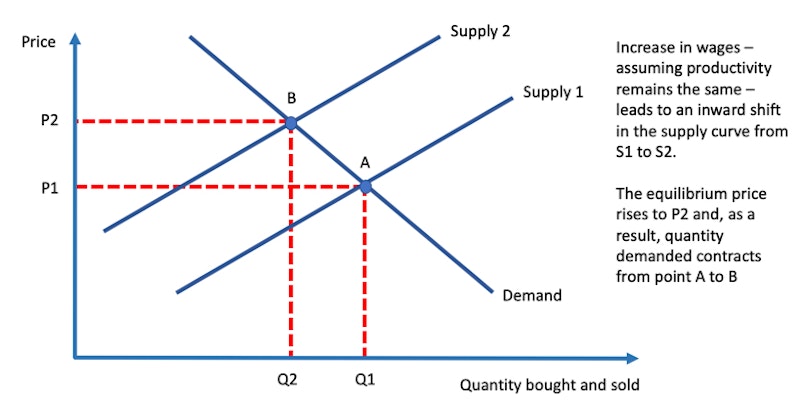
Draw a diagram to show the effects on the market for a good of an increase in wages (ceteris paribus).
Increase in wages – assuming productivity remains the same – leads to an inward shift in the supply curve from S1 to S2.
The equilibrium price rises to P2 and, as a consequence, quantity demanded contracts from bespeak A to B
Concatenation of reasoning - increase in demand
- Marketplace demand for a product increases (ceteris paribus)
- This can be shown past an outward shift of the demand bend.
- An outward shift leads to an increase in the equilibrium market toll
- Higher prices reflect that consumers accept an increased willingness and ability to pay
- College prices then point producers to expand their supply to meet ascent demand leading to
- An increase in the equilibrium quantity bought and sold
Chain of reasoning - increase in supply
- Market supply increases due to a rise in the number of firms / suppliers
- This can be shown by an outward shift of the supply curve
- If supply increases, this volition pb to a fall in marketplace equilibrium cost
- At lower prices, in that location is an increase in the real purchasing power of consumer income
- Therefore there will exist an expansion along the demand curve leading to
- An increase in the equilibrium quantity bought and sold
Cost mechanism
Give two advantages and two disadvantages of allowing the price mechanism to operate without any government intervention:
ADVANTAGES
- Prices send signals that reflect consumer preferences – the market is quicker reverberate changing need
- When making their choices, consumers may non have full and accurate information
DISADVANTAGES
- Price changes human action as a signaling device for businesses due east.g. higher prices stimulate expanded supply
- Market prices might be high mainly because firms are exploiting their monopoly power

How Markets Work Unit Test,
Source: https://www.tutor2u.net/economics/reference/how-markets-work-introductory-market-concepts
Posted by: mooreoffing.blogspot.com
0 Response to "How Markets Work Unit Test"
Post a Comment